Three Whatcom school districts welcomed students back this week. Here’s how it went
A total of 65 Blaine kindergarten students returned to school this week for in-person classes, for the first time since March when schools in Washington state closed and switched to online learning because of the COVID-19 pandemic.
The next group of 65 kindergartners will head back next week to Blaine Primary School as part of the district’s schedule, where the two groups of students alternate their weeks at school while continuing with online learning as well, according to Superintendent Christopher Granger.
Public school districts in Whatcom County are slowly starting to bring back groups of their youngest learners as well as other students with the greatest needs.
Blaine welcomed its kindergarten students back starting Monday, Oct. 12, as well as its 11 students at Point Roberts Primary School. Lynden is bringing back its students in kindergarten to second-grade and Nooksack Valley is bringing in students in kindergarten to fifth-grade — both starting on Tuesday, Oct. 13.
All seven of Whatcom County’s school districts started the school year with remote learning and six are now starting to bring some students back, although Mount Baker School District has yet to announce when it will do so.
Students returned to new safety measures that included mask-wearing and health questionnaires.
The Bellingham Herald asked Blaine, Nooksack Valley and Lynden school districts about their first days of in-person instruction this school year.
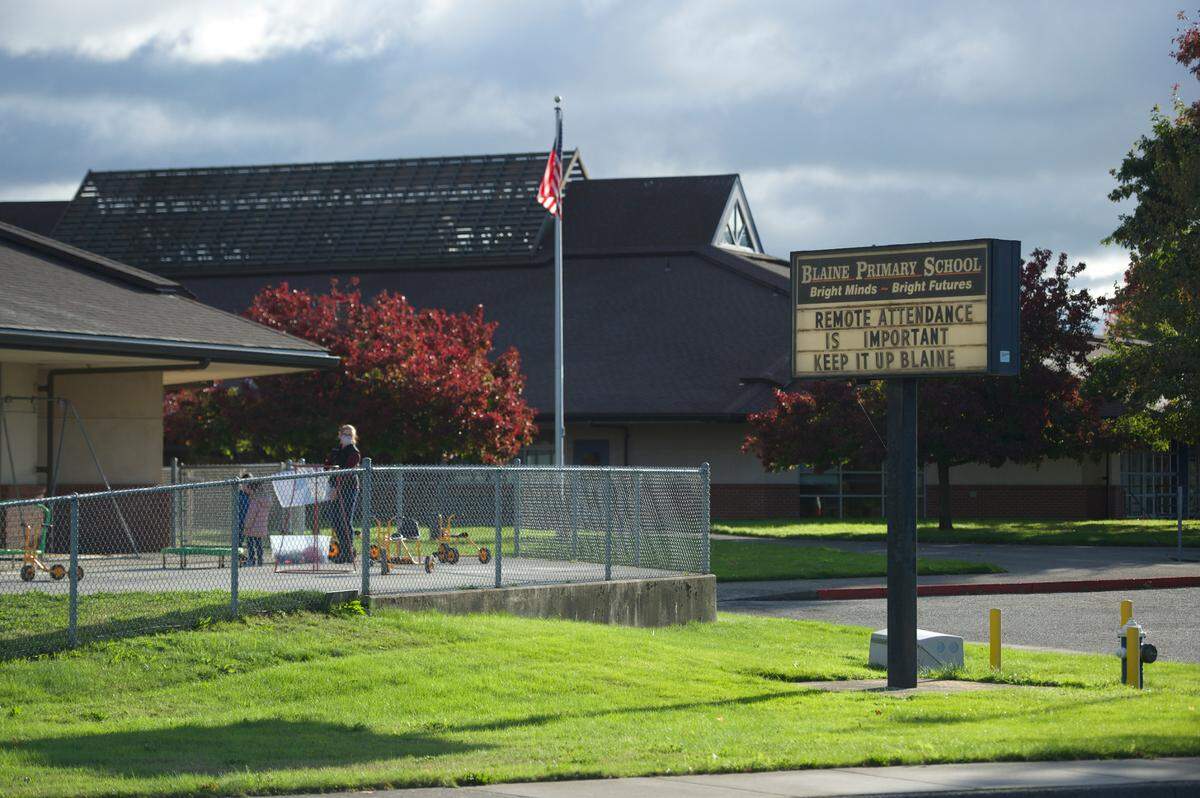
Blaine School District
How did it go Monday?
Granger: “By all accounts, this went well and it was exciting to welcome a larger group of students to the building. We learned some things about the check-in process and will continue to work with our families to encourage them to complete the wellness screening prior to getting on the bus or arriving on campus.”
In addition to its kindergarten students, the district also has brought back, since Sept. 21, a small number of students in Life Skills, preschool and those without internet connection.
The school district has 167 kindergarten students enrolled this year.
What did the school day look like for students compared to what it would have been like pre-pandemic?
Granger: “The in-person school day is shorter, four hours, with asynchronous activities to complete at home in the afternoon. We arrived at this schedule, with limited in-person time, based, in part, on safety measures. Our team has worked hard to have focused, instruction-based activities to maximize their time with students.”
What health and safety measures were in place? For example, what did lunch and recess look like?
Granger: “To reduce the time students are in proximity with others without masks on, we are not serving meals on campus. This decision was made, in part, based on feedback from parents. We have implemented mask breaks to incorporate some socially distanced outdoor activities throughout the day. At this time recess and play equipment are not being utilized.”
Students don’t have to wear masks when they’re outside, which is also when they can have a snack, according to school district information.
Did students’ teachers and paraeducators also return? Or did you need to accommodate those who couldn’t provide in-class instruction because of health issues or didn’t feel safe doing so?
Granger: “As we have returned students to this campus, the teachers and paraeducators have returned to the building as well. Those employees who for various reasons can’t return to the building, and for whom alternate assignments are not currently available, are accessing leaves allowable in the bargained agreement.
“The health and safety of our employees and students remains a critical concern and will continue to be a factor in our decision-making.”
Nooksack Valley
How did it go Tuesday?
Cindy Stockwell, assistant superintendent: “Not unlike the typical first day of any school year, the day was filled with new routines, new faces and lots of anticipation. But nearly everything about these routines were different than any typical year, ever.”
She said principals, teachers and all support staff were ready and greeted students and families with excitement.
“Getting students checked in at the beginning of the day, settled and in classrooms took a little longer than usual due to safety and health requirements. Principals anticipate that with time, practice and a few adjustments this will improve,” Stockwell said.
Teachers and students spent time learning and practicing wearing their masks, washing hands and watching their social distancing as well as other daily routines for the start of school.
“Overall, teachers and students appeared genuinely happy to be in their schools and classrooms,” she said.
How many students returned?
About 400 students in grades kindergarten through fifth grade were at school on Tuesday, Oct. 13, in the district’s three elementary school buildings, according to Stockwell.
The district is in a hybrid A/B schedule so another 400 students were expected on Wednesday, Oct. 14.
Hybrid means that students are learning online and in the classroom. An A/B schedule means that students in group A are in class part of the week while group B students are in class the other part of the week.
Some students aren’t returning to school for their classes.
“About 120 students are currently remaining in remote-learning mode,” Stockwell said. “Typically, we would anticipate enrollment at K-5 to be approximately 1,000 students.”
In addition to these students, Nooksack Valley has been bringing small groups of students with no internet connectivity or who have special needs back to its school buildings since Sept. 14.
What did the school day look like for students compared to what it would have been like pre-pandemic?
Stockwell: “Many parts of the day remain as typical as possible given the requirements. There is time for reading, writing, math, physical education and music. New routines for masks and mask breaks are being taught, more frequent hand-washing and learning how to stay socially distanced were part of the first day of school this year.”
Students have been placed in cohorts, also referred to as pods, with their teacher and they stay together, including for lunch and recess.
What health and safety measures were in place? For example, what did lunch and recess look like?
Stockwell: “All health and safety requirements were in place for the first day. Temperature and symptom checks are performed by paraeducators riding buses before students board or upon arriving at school with a parent. Wearing face coverings , hand-washing/sanitizing and distancing are part of our regular routines.”
Students were served a sack lunch in their classrooms, she said.
“Recess is outside, rain or shine,” Stockwell added. “Students remain in their pods and have assigned zones in order to maintain distancing.”
Did students’ teachers and paraeducators also return? Or did you need to accommodate those who couldn’t provide in-class instruction because of health issues or didn’t feel safe doing so?
Stockwell: “With the exception of two elementary teachers who identified as high risk and were granted an alternative assignment, the remainder of our K-5 staff, both teachers and paraeducators, returned to our school buildings.”
Lynden School District
How did it go Tuesday?
Jim Frey, superintendent: The district’s kindergarten to second-grade students started on Tuesday at its three elementary schools and Lynden Academy, its parent partnership program.
“Our student enrollment at elementary schools is lower than normal as some families have chosen to be in an online, remote or home-school model. We have made staffing adjustments based on requests for alternative work assignments. As we add more grade levels back to in-person learning we will make staffing adjustments as necessary.”
“I would like to give a big shout out to our principals and staff at each of our elementary schools. They have worked extremely hard to get to this point and make sure we have a safe environment for both kids and staff,” he said.
“It has been a great team effort and we are excited to have kids at school,” Frey said.
How many students returned?
Frey: A total of 625 students across the three elementary schools and its Lynden Academy.
Starting the week of Oct. 19, students will be in school four days a week. On Fridays, they will learn remotely at home, according to Frey.
What did the school day look like for students compared to what it would have been like pre-pandemic?
Frey: “The student day looks a bit different as every child has their temperature checked at the start of the day and families attest that children do not have any symptoms. All students and staff are wearing face coverings. Classrooms have seating that is 6 feet apart and we are cohorting groups as much as possible to reduce mixing of students.”
What health and safety measures were in place? For example, what did lunch and recess look like?
Frey: “Health and safety protocols include emphasis on hand hygiene, distancing and face coverings. Classes such as physical education and music have been adapted to reduce high-risk activities such as singing and high levels of physical exertion.
“Cohorting is maintained at recess and students are eating lunch in their rooms. Students are given mask breaks. We are following CDC guidelines for cleaning, which includes a greater focus on high-touch surfaces and sanitizing areas between uses and we are limiting shared supplies and equipment.”
Did students’ teachers and paraeducators also return? Or did you need to accommodate those who couldn’t provide in-class instruction because of health issues or didn’t feel safe doing so?
Frey: Saying he didn’t have all of the specifics, he provided a general overview.
“Classroom teachers and other support staff returned to in-person learning. There have been some adjustments based on individual considerations for individual’s specific circumstance,” he said.
This story was originally published October 16, 2020 at 5:00 AM.